
Maker · Vegetables
Elenbaas Zeegroenten
Salt-marsh greens that started in the Zeeland salt marshes and now also come from the greenhouse, so you can feature samphire and sea lavender year-round instead of just in summer.
The story
Who's behind it
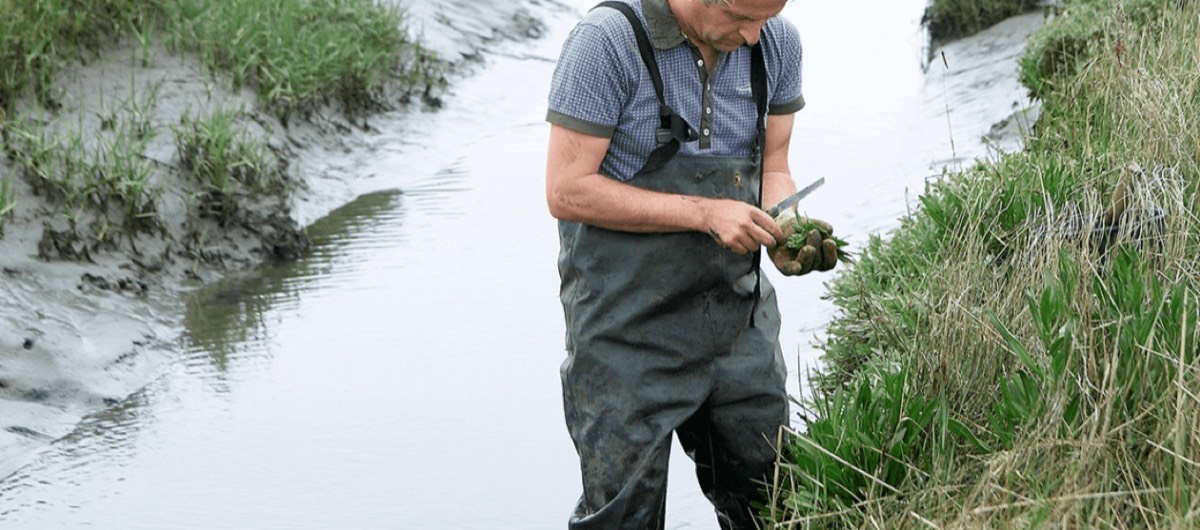
Elenbaas Zeegroenten is run by Hans Elenbaas in Middelburg. It's family work spanning three generations. His grandfather was already cutting sea lavender and samphire from the Zeeland marshes in the 1930s, his mother sold it door-to-door. Hans went out into the mud as an eleven-year-old with his brother to search for salt plants. That handwork has endured: the harvest is demanding and labour-intensive, and sorting and packing still happen mostly by hand.
What started as wild gathering has grown into a business supplying hospitality venues, specialist shops and supermarkets. About 60 per cent goes to Dutch customers, the rest to export markets.
What makes it different
Wild-harvested salt-marsh greens have a short season. Sea lavender and samphire peak in summer, picked with permission from the marshes, and outside that window it's difficult to supply. To bridge that gap, in 2018 Hans started, together with grower Aart-Jan Bil from Kerkwerve, greenhouse growing under the name Nieuwe Zeeuwse Zilte Teelten. So some of the salt vegetables come from the greenhouse, grown in soil with salt water rather than in open nature.
This combination of wild and cultivated is the core. You get the flavour of the marshes in peak season and yet a reliable supply year-round. The vegetables are crunchy from the salt, fresh from the water and full of flavour from the minerals in the soil. Beyond the classics samphire and sea lavender, new varieties are arriving, like sea aster, sea fennel and the sea bean, a tiny plant about two centimetres long that pops open on your tongue like a cherry tomato.
How to stand out with this
Salt vegetables do the work of salt on the plate, but with crunch and colour. A handful of samphire with raw mackerel or scallop gives your guests something they won't easily make at home. Sea lavender quick through brown butter alongside turbot is five minutes' work and immediately puts the coast on the plate.
The real story is the sourcing: the Zeeland marshes, three generations, harvested by hand. That's what you tell at table. If you want to offer it year-round, the greenhouse growing helps you through the winter. Ask what comes in that week, because the range shifts with the season.
Chef’s tip
Samphire and sea lavender are naturally salty, so taste before adding salt. Blanch for no more than 30 seconds and shock in cold water to keep the crunch and colour. Sea lavender in brown butter is enough alongside fish.
How to use it
Ideas for your menu
Samphire with raw fish
Raw mackerel or scallop with crunchy samphire, a touch of citrus and oil. The salt vegetable replaces the salt grain on the plate.
Sea lavender in brown butter
A quick pass through brown butter alongside turbot or sea bass. Five minutes work, and the plate tastes of the coast.
Sea aster and shellfish
Sea aster raw or just warm with langoustine or oyster. Also works cold in a salad with fennel.
Sea bean as garnish
The tiny, crunchy sea bean as the final note on a plateau or amuse. Pops open like a cherry tomato.
For your menu
“Samphire and sea lavender from Elenbaas Zeegroenten, wild-harvested from the Zeeland salt marshes”
Products from Elenbaas Zeegroenten
What we carry from this maker
Sea lavender (Elenbaas, Zeeland)
By the kilo and by the box. Peak in summer, wild-harvested from the marshes.
Samphire (Zeeland)
By the kilo and by the 1-kilo box. Zeeland harvest; imported outside season.
Salt-marsh seasonal vegetables
Rotating stock, such as sea aster, sea fennel and sea bean. Ask what comes in that week.
Prices and availability are in the portal. Not a customer yet? Become a customer or log in to order.
Taste it in your own kitchen
Book a no-obligation tasting with Niels. No contract, just tasting.